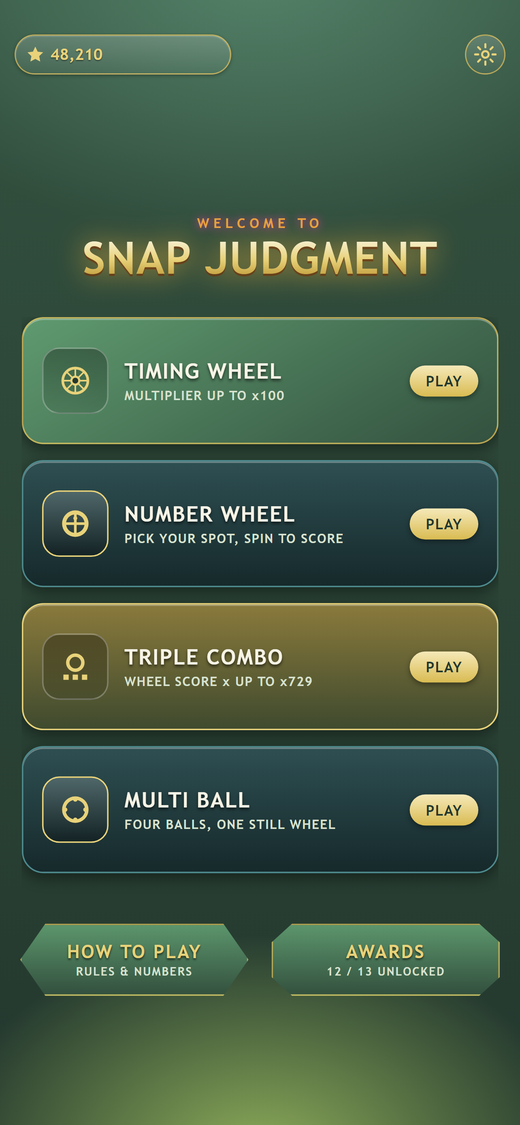
Four small wheel games built around one honest question: can you
read a moving thing and commit at the right instant? Everything runs on your device.
Nothing is sent anywhere, because there is nothing to send.
0Modes
0Awards
0Network requests
0Accounts
0Ads & purchases
Mode 01 — pure skill
Timing Wheel
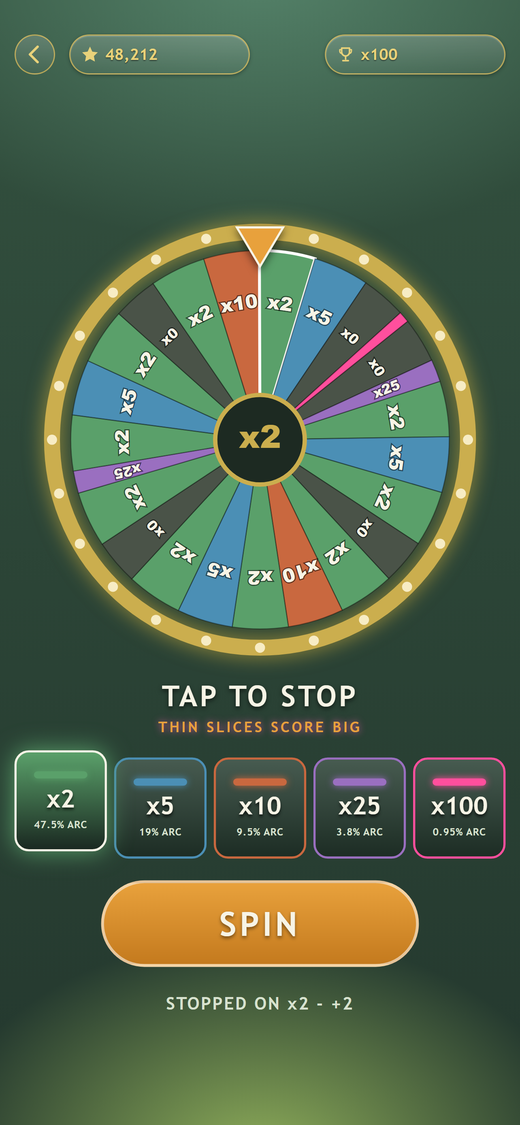
Tap once to spin up. Tap again to stop. The wheel coasts exactly two more turns
and lands on the slice that sat under the pointer the instant you tapped —
the coast adds no lead at all, so there is no secret offset to memorise. The rim
turns twice a second. That is the whole game.
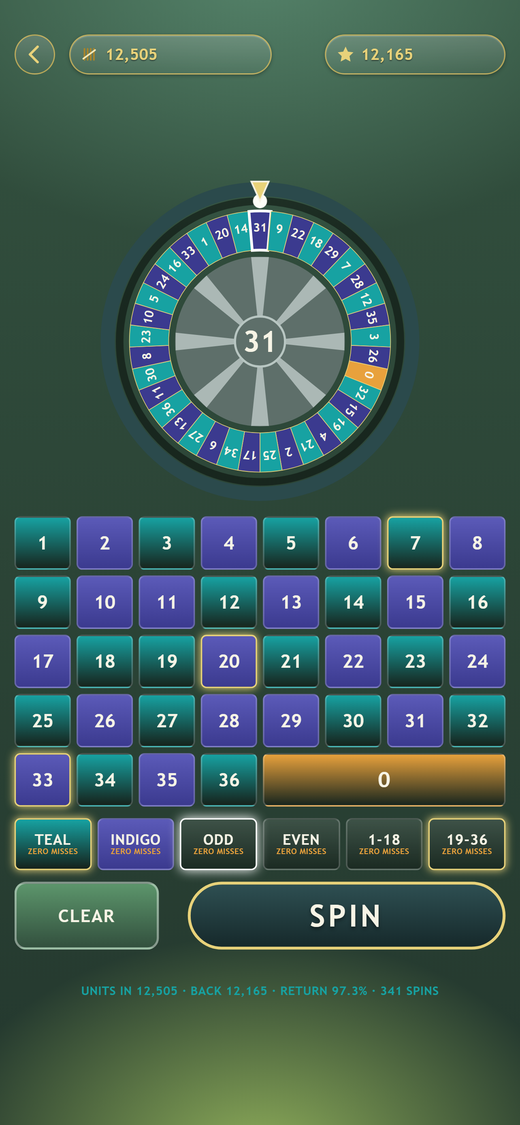
Thirty-seven spots. Pick some, roll the ball, and watch what the numbers actually
do over hundreds of rounds. The units here are tally marks, not currency —
there is no balance, nothing to top up and nothing to redeem.
A single spot comes back as 36: the 1 you used plus 35 extra. But there are 37
spots. That one extra spot is the entire gap — and the reason the long-run return
settles at 36 / 37 = 97.3%. The figure is not a promise; it is the thing
this mode exists to show you.
Mode 03 — no timing needed
Triple Combo
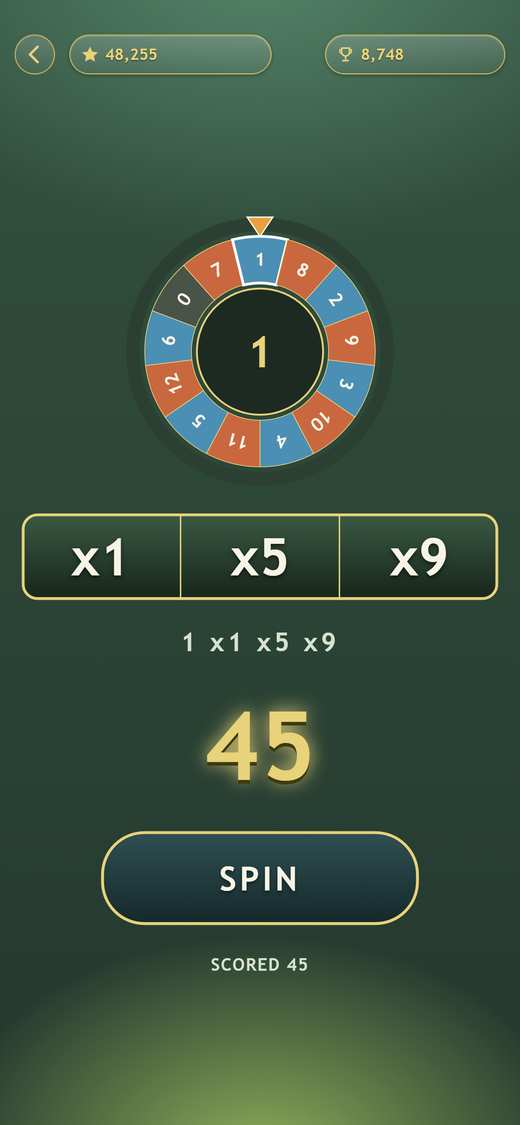
A 13-spot wheel deals a base of 0 to 12, then three multiplier columns stop one by
one, each worth x1, x3, x5, x7 or x9. The total is the base times all three.
An average round is 750 — though most land well under that; the median is
315. The top end is 12 × 729 = 8,748. And a base of zero, 1 in 13, zeroes
the whole round even if the columns land x729.
Mode 04 — four at once
Multi Ball
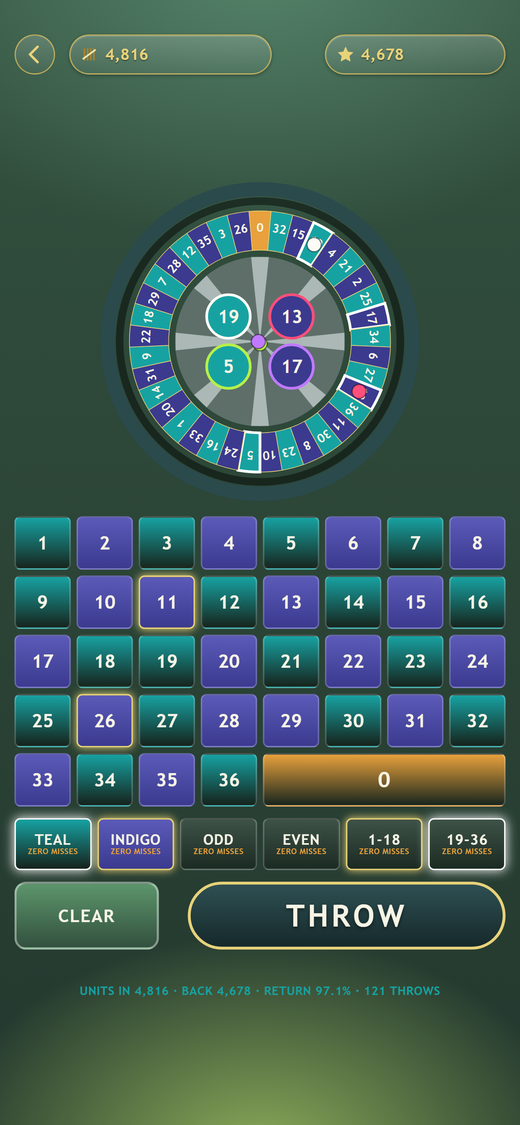
The same 37 spots and exactly the same chances as Number Wheel, with one change:
the wheel never turns. Four balls roll out from the centre, hit the rim and bounce
into four different numbers.
Each pick uses 4 units — one per ball — and every ball is judged against it on its
own. A ball on zero only affects that one ball. More balls narrow the swings; they
do not change the chances.
What this game does not do
Most of this list is normally buried in a privacy policy. It is here
because it is the part we would want to read first.
No network requestsNot one. The game never contacts a server, so there is no traffic to log.
No accounts or sign-inNothing to register, nothing to recover, no e-mail asked for.
No ads and no purchasesNo ad SDK, no store, no subscription, nothing gated behind payment.
No analytics or trackingNo SDK, no identifiers, no crash reporter, no profile of you anywhere.
No currency of any kindScores and tally marks only. Nothing in the game has real-world value, and nothing can be exchanged for anything.
No image or audio filesEvery shape is drawn in code and every sound is generated as it plays. It is a very small download.